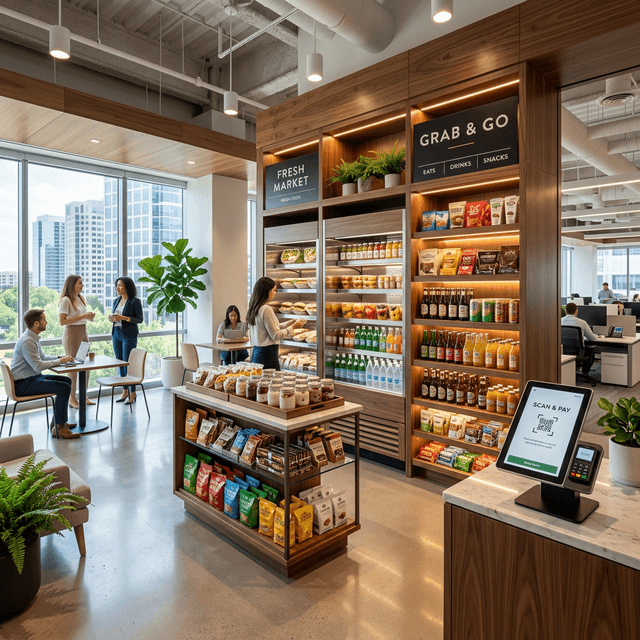
A useful vending program starts with the workday. Before choosing a machine, identify who is actually in the building, when people take breaks, and what they cannot conveniently buy nearby. An Atlanta office with three busy in-person days has different needs from a distribution facility with overnight shifts. A clinic staff lounge has different access rules from a public lobby. Equipment should follow those differences.
This guide helps workplace managers prepare a realistic brief for Atlanta vending and break room services. It covers demand, equipment, placement, costs, delivery, and ongoing management. The examples are planning scenarios, not claims about customers or installations. The objective is a service your team can use consistently, with responsibilities and costs understood before equipment arrives.
1. Count people on site, not names on a payroll
Ask reception, HR, or facility supervisors for typical attendance by day and shift. Do not use your company's total headcount as the only demand estimate. Include contractors and other regular users if they can access the break room, and distinguish them from occasional visitors. Record where those users work: a building may contain several teams whose break areas are separated by badge-controlled doors.
The Atlanta Regional Commission's Regional Commuter Survey examines travel to work and telework patterns across the region. It provides regional context, but it cannot tell a provider how many people will use your particular room. For your placement assessment, your own attendance records are more useful than a citywide average or a general assumption that everyone works Monday through Friday.
Build a simple weekly grid. List morning, midday, evening, and overnight users for each day, together with major meeting days and scheduled production breaks. Use a representative week and note whether it includes an unusual event. A workplace with concentrated Tuesday and Wednesday attendance needs a different stock plan from one with stable daily occupancy, even if their weekly totals look similar.
Look at the length and location of breaks
A short break can make a distant food option impractical. Measure the journey from the workstation to the proposed vending area, rather than judging the room from a floor plan alone. Include the time needed to pass security, wait for an elevator, or walk between warehouse zones. Staff may value fast access to drinks more than a large assortment of products they cannot reach comfortably.
For shift workplaces near the airport or in the south metro, list the actual overlap between shifts. A beverage machine that looks adequately stocked at midday could be heavily used before an evening crew arrives. Ask how service visits can fit around those patterns. Do not promise round-the-clock support simply because equipment is available outside office hours; support and repair arrangements need their own agreement.
Ask what the room is supposed to solve
Use a short staff survey with practical questions: what do you currently bring, what do you leave the building to buy, and what would you purchase on site? Include water, breakfast, lunch, coffee, and snacks rather than asking only about candy brands. Keep responses anonymous where possible. Dietary preferences are useful; personal medical information is not needed to design the product mix.
2. Compare vending, micro markets, coffee, and pantry service
Traditional vending keeps products inside enclosed equipment until purchase. It can suit shared spaces, compact rooms, and sites where open shelves would be difficult to supervise. Confirm the machine's actual payment options, item capacity, refund process, and ability to vend the products your staff requested. A familiar machine with the right assortment can be more useful than a larger installation selected for appearance.
A micro market uses shelves, coolers, and self-checkout. Customers can browse products and read labels before paying. It usually requires more dedicated room and a clear access policy. Discuss employee-only access, checkout connectivity, refrigeration, stock control, and responsibility for missing inventory. An open market should be selected because the space and demand support it, rather than because it is automatically an upgrade.
Office coffee service addresses a separate daily need. Ask whether the proposal includes equipment, beans or pods, tea, cups, filters, cleaning supplies, and routine servicing. Identify who will empty waste containers and perform the daily tasks. A brewer that needs attention throughout the day is not a complete solution if nobody has time to manage it.
Pantry service is employer-funded: employees take refreshments without paying at a machine or kiosk. The employer pays for the agreed products and services. Set a budget, ordering authority, and replenishment process before launch. “Complimentary for staff” describes the employee experience; it does not mean the products are free to the company.
Use a staged approach when demand is uncertain
A hybrid office may begin with coffee and a compact snack-and-drink setup, then consider a market after actual purchasing patterns become clear. A facility might prioritize a dedicated beverage machine before adding more food choices. Ask how equipment can be resized or relocated, what notice is required, and whether changes affect the agreement. Avoid designing the largest possible room before daily use is understood.
3. Understand what no-cost placement means
No-cost vending placement is an eligibility-based arrangement. A provider may supply equipment and installation without charging the host when expected sales, service access, location, and operating conditions make the placement workable. It is not an automatic entitlement for every business. The assessment should consider daily users, shifts, purchasing demand, route availability, and the suitability of the proposed room.
Products still have prices. Staff or visitors generally pay for the items they buy from a vending machine or market. Employer-funded pantry products, subsidized purchases, coffee, water service, and optional equipment arrangements can have separate recurring charges. Ask the provider to distinguish these categories in writing so an equipment-placement offer is not mistaken for a completely free break room program.
Site preparation may also create costs. Electrical work, plumbing, network changes, cabinetry, building approvals, or an unusual delivery requirement should be identified before installation. Ask who arranges each task and whether it is included in the quote. If your landlord or facilities department requires work by approved contractors, allow time for that process instead of treating it as a last-minute installation detail.
Request a clear commercial summary
Your proposal should explain equipment ownership, products offered, purchase prices or the pricing process, employer-paid services, installation responsibilities, service frequency, and cancellation terms. Ask about minimum usage expectations, exclusivity, removal, damage, and any early termination conditions. Do not assume the absence of a placement fee means the absence of a contract or other responsibilities.
For a pantry program, agree how spend is controlled. Possible questions include whether the operator provides an inventory report, who can approve additional orders, and how seasonal attendance changes affect supply. For coffee, ask whether consumables are billed separately from equipment. For subsidized vending, clarify how staff discounts are funded and reconciled. These questions help compare proposals without relying on an invented universal price.
4. Plan delivery and service access for the actual Atlanta address
The name of a neighborhood is not a delivery plan. A Midtown office, a Buckhead tower, and a Decatur staff room may each require different access arrangements. Give the provider the specific address, floor, room, delivery entrance, and building contact. Confirm service coverage for that address before agreeing a launch date.
In a multitenant building, ask management about loading-dock reservations, freight-elevator booking, vendor badges, delivery windows, and insurance documentation. Measure the route from the unloading point to the final placement. Include door openings, tight corners, thresholds, and elevator dimensions. The equipment footprint alone does not tell you whether the machine can enter the building.
For a facility with controlled access, identify an escort or approved contact and a backup person. Explain whether a service driver needs a safety briefing, parking instruction, or personal protective equipment. Ask whether restocking can occur while staff use the room. If a delivery window changes, both the provider and building contact need an agreed notification process.
Check the room before agreeing equipment
Record usable wall length, ceiling restrictions, outlet locations, cooling requirements, and the path people take through the room. Account for doors opening, seating being occupied, cooler doors swinging, and users waiting to pay. Keep circulation, access to building systems, and emergency routes clear. Ask the equipment provider for model-specific dimensions and installation needs; estimates from a generic machine image are insufficient.
If alterations are needed within the city, the City of Atlanta's Buildings and Zoning guidance is a starting point for determining the appropriate building process. Locations elsewhere in the metro may have different local authorities. Have your building manager or qualified contractor confirm requirements for the actual work and address before making changes.
Accessibility belongs in the placement discussion from the beginning. Consider the approach to the machine, visibility of labels, payment controls, product retrieval, and circulation around the equipment. Ask for an accessible layout review when needed. A room should serve the people using it, including those who cannot comfortably reach a high control or navigate a crowded queue.
5. Build a product mix that earns repeat use
Start with a manageable assortment. Include familiar choices alongside products that answer specific requests, such as lower-sugar beverages or more filling snacks. For longer shifts, ask whether breakfast and meal options are appropriate. For a small office, a narrow assortment that turns over reliably may work better than a broad range with products that linger.
Discuss how nutrition and ingredient information will be available. Staff should be able to identify products and review labels; avoid describing every item as suitable for every dietary need. Ask how requests are recorded and how substitutions are communicated. If a requested product is unavailable, a clear alternative is better than quietly replacing it with an item someone cannot use.
Fresh food adds operating responsibilities. Ask how refrigerated products are transported, stored, monitored, rotated, and removed if refrigeration fails. Clarify who receives alerts and who can isolate affected products. Georgia's Department of Public Health food-service resources provide official guidance. Confirm which agency and requirements apply to the specific operation; do not assume every vending or market arrangement has identical permitting obligations.
Separate replenishment, maintenance, and refunds
A replenishment visit replaces stock. A maintenance call fixes equipment. A refund request resolves a purchase problem. Each needs a clear path. Ask how employees report a failed vend or checkout issue, what information they should provide, and where the contact instructions will be displayed. A workplace manager should not have to collect employees' card details to obtain help.
Agree what happens when the payment network is unavailable. Does the equipment support another payment method? Who troubleshoots connectivity? Can the building's guest network be used, or is another connection required? Have IT review the proposed setup before installation. Keep employee credentials and business systems separate from the payment equipment's operating arrangements.
For restocking, ask which information changes the route or product quantity. Sales patterns, repeated stockouts, expiry, requests, and attendance shifts should inform adjustments. A fixed calendar may be a useful starting point, but the program needs a way to respond when its busiest hours change. Share planned closures and major meetings early so the operator can prepare rather than react.
6. Match the program to three common workplace situations
A hybrid office with a shared kitchen
Begin by mapping in-person days and checking who controls the room. Compare a compact machine with an employer-funded pantry allocation and coffee service. Decide whether visitors can use the products and who approves pantry spending. If attendance varies sharply, ask about adjustable ordering rather than assuming every week needs the same quantity.
A warehouse with several shifts
Map breaks across the full day and identify the easiest safe access point for each crew. Review beverage capacity, quick payment, filling snacks, and service access around shift changes. If separate work zones cannot share a room easily, discuss whether additional placements are justified by demand. Employee convenience and safe circulation should drive the layout.
A clinic or school staff lounge
Start with staff-only access and approved delivery procedures. Keep the program separate from visitor or student areas when that is the facility's policy. Ask about term breaks, holidays, and fluctuating staffing. A managed coffee or vending setup can be practical, but the operator needs to know the building's safeguarding and access requirements before arranging visits.
7. Launch with a named owner and a review plan
Assign a workplace contact and backup before delivery. Share installation timing, room access, parking, and final equipment details with all relevant teams. After setup, check that payment, labels, product retrieval, and contact instructions work. If the operator conducts purchase tests, agree how they will be performed without using employees' personal payment information or creating confusion about refunds.
Tell employees what is available, whether purchases are employee-paid or employer-funded, and how to request help. Put simple instructions near the equipment. For an open market, explain checkout expectations and the rules for visitors. For coffee, show the daily cleaning and supply tasks and identify their owner. A short introduction can prevent avoidable misuse and uncertainty.
Arrange an early review after a representative period of use. Compare attendance with sales and staff feedback, then look at repeated stockouts, unused products, service issues, and pantry spending. Adjust a few items at a time so the effect is understandable. Revisit the program when shifts, attendance, office layout, or building access changes significantly.
Your quote-request checklist
- The address, floor, and proposed room, plus photographs or measurements if available.
- Typical daily attendance, shift times, break lengths, and access restrictions.
- The priority: snacks and drinks, fresh food, coffee, water, pantry, or a combination.
- Delivery requirements, electrical and network readiness, and building approvals.
- Employee-paid versus employer-funded products and any budget constraints.
- Desired timing, decision maker, existing equipment, and current agreement considerations.
You do not need every answer before making an inquiry. Mark unknowns clearly and ask for an assessment. A useful proposal explains why a particular setup fits your workplace, what eligibility depends on, and which expenses belong to the employer or purchaser. That is a stronger starting point than a promise of free service with no conditions.
Plan your Atlanta break room
Explore our Atlanta service areas and service options, then request a free quote with your address, daily attendance, and priorities. We can review site suitability, placement eligibility, and separately quoted services before you commit to a setup.
Sources reviewed October 5, 2026: Atlanta Regional Commission commuter resources, City of Atlanta building guidance, and Georgia Department of Public Health food-service resources. Local context informs the planning questions above; it is not evidence of a customer relationship, guaranteed placement, or a specific workplace outcome.